






Updated April 1, 2026
Localization is quite a specific topic that is thoroughly understood only by a limited number of people who actively study and follow developments in this area. Most people view this issue in a simplified way – whether an ERP can be used in a particular country and whether it is adapted for that market. As the SaaS model continues to gain popularity, where a business management system (ERP) is delivered as a service, it becomes increasingly important to understand not only what localization is, but also what its key components are.
What is ERP localization?
Localization is the adaptation of an ERP (Enterprise Resource Planning) system to meet the legal and language requirements of a specific country. Many ERP vendors, in one way or another, emphasize that organizations operating in a particular country must comply with that country’s laws, regulations, directives, and other legal requirements. Failure to comply with or properly manage these obligations can lead to serious issues for an organization’s operations and even its long-term viability.
In other words, this often implies that companies should acquire only a localized ERP system – one that can immediately help them adapt to the specific requirements of a given country or even a particular region. These are general statements commonly found in marketing materials from major ERP vendors. However, the reality is that localization consists of a wide range of functionalities – it is not just about translating the system into a local language.
In other words, having only a translated system is not sufficient to claim that it is localized. A system can be considered truly localized when:
- it supports the preparation and submission of required tax reports to local tax authorities (i.e., reports that all companies must provide);
- it includes a full translation into the local language;
- it offers solutions that facilitate doing business in a specific country.
Microsoft, unlike other major ERP vendors, offers several ERP solutions in its portfolio: the decentralized Microsoft Dynamics 365 Business Central (formerly NAV / Navision, hereafter D365 BC) and the more centralization-oriented Microsoft Dynamics 365 Finance & Supply Chain Management (formerly AX / Axapta / Finance & Operations, hereafter D365 F&SCM).
The chosen ERP solution determines differences in localization development strategies. For example, in the case of the D365 F&SCM platform, localization is primarily handled by the vendor itself (as this ERP is designed for large enterprises and corporate groups). Meanwhile, for D365 BC (which, according to the vendor, is intended for small and medium-sized businesses), localization is more often developed by Microsoft partners.
Microsoft Dynamics 365 Business Central localization can be categorized into the following options:
- localization for the D365 BC on-premises version;
- localization for the D365 BC cloud version (whose latest name is Microsoft Dynamics 365 Business Central Online).
OIXIO delivered localization for the D365 BC on-premises version (starting from version 14) within a few months after the release of D365 BC version 14. Meanwhile, the release of localization for D365 BC Cloud depended more on Microsoft and the resources allocated to reviewing and certifying localization solutions, as well as the speed of technical preparation.
More detailed conclusions can be drawn from the table below, which shows that:
- the real possibility to obtain D365 BC as a SaaS (Software as a Service) localized for Lithuania emerged with version 17;
- D365 BC had SaaS versions 14, 15, and 16 available, but there was no localization for Lithuania;
- for the D365 BC on-premises license, it was possible to obtain localization for Lithuania.
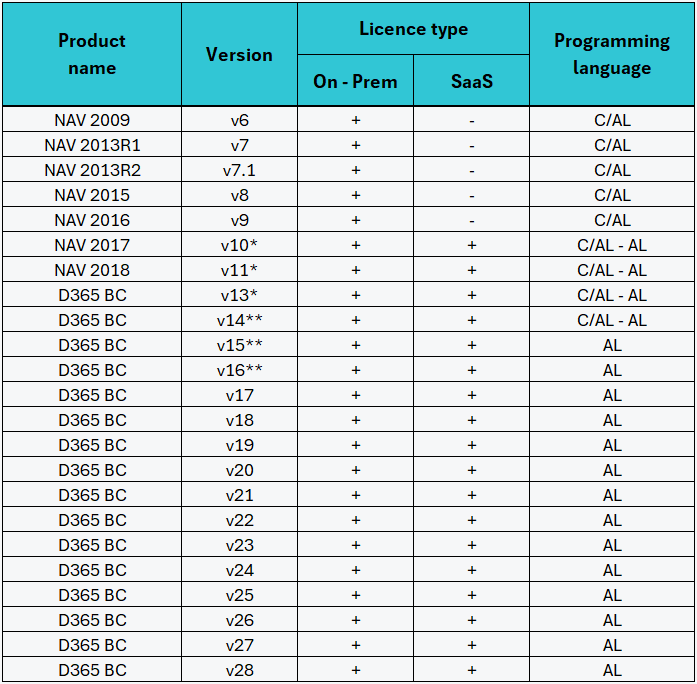
*SaaS was available, but localization was not provided.
*SaaS was available, but localization for Lithuania was not provided.
For those interested in the historical context, Microsoft mentioned Lithuania in its September 2020 announcement about D365 BC version 17, alongside Ireland and Brazil.
Who handled localization in the past, and who will handle it in the future?
The history of localization development has seen various approaches. In the past, Microsoft often handled localization itself. However, it later decided not to prepare or maintain localizations for new NAV versions in other countries. The last version for which Microsoft managed localization was NAV 2009 R2. With the release of NAV 2013 R1, the responsibility for developing localizations was entrusted to local Microsoft partners.
In Lithuania, four partners initially collaborated on creating the localization, but this did not fully resolve a key issue: which partner would own the localization? As a result, the market ended up with four separate localization solutions for a single NAV version. For subsequent versions, partners no longer collaborated: each developed, maintained, and supported its own solution. This situation persisted until the release of NAV 2018.
In 2019, with the release of the latest NAV version under its new name, Microsoft Dynamics 365 Business Central, three local partners in Lithuania again began collaborating on its localization.
The latest D365 BC version also introduced a new programming and customization deployment technology called extensions (or apps), gradually phasing out the older C/AL programming language.
What does the ERP localization cover and what benefits does it provide to clients?
D365 Business Central localization stands out because it is implemented as extensions and consists of two main packages: BASIC and EXTENDED. The complete list of D365 BC localization apps (more than 15, not including additional apps offered by partners) along with their descriptions is available on the localization webpage and on the Microsoft Marketplace platform.
D365 BC version localization follows a unified pricing model:
On-premises: you can purchase a specific solution or a solution package for a fixed price:
- BASIC consists of 7 apps – €3,500 + BREP.
- BASIC + EXTENDED – €7,000 + BREP.
Cloud (Online): you can purchase individual apps or the packages mentioned above. There are two options:
- User – suitable when only a few users are using D365 Business Central;
- Tenant – suitable when multiple users are using D365 Business Central (the license is purchased for the managed company account).
Localization has not been and is not a key competitive advantage. Ultimately, this gives users easier options to change their servicing partner. Some partners used to make modifications within the localization scope rather than in the public scope (as required by Microsoft policy), which made switching partners very difficult, because a new partner could not access those modifications.
What should you not expect from localization, and why?
There are certain functionalities that major ERP vendors (SAP, Oracle, Infor, Microsoft), not to mention smaller ones, generally do not include in their localization. These are solutions that are highly specific to a particular country, a certain economic sector, or a narrow group of clients, rather than the market as a whole. Functionalities that require specialized knowledge in a narrow area are usually uninteresting to vendors because they demand significant resources both to develop and to maintain (for example, payroll processing, packaging solutions, etc.).
From our perspective, one of the most in-demand functionalities in the market is payroll management. Why is it often excluded from localization? From a business standpoint, it seems logical to expect that operating in a country would require compliance with its payroll-related legal requirements. The problem is that labor regulations change frequently, which means maintaining functionality in line with a country’s evolving legal framework is a major challenge. It requires significant time and investment, with no guarantee that the functionality will be developed on time – for instance, there have been cases where changes to the Labor Code come into effect the following month, and Lithuania is no exception.
As a result, this represents a substantial risk that vendors are unwilling to take on. Sometimes even local partners avoid taking this risk unless they have sufficiently large resources to dedicate to this specific area. Managing such risk effectively requires a dedicated team that continuously monitors legal requirements and updates to meet clients’ needs – and a sufficiently large client base to justify these efforts.
Future of Microsoft Dynamics 365 Business Central On-premises
Microsoft has issued multiple statements indicating that the On-premises version will be phased out and that the future lies entirely in the Cloud. These announcements should be considered in the context of both past similar statements and actual circumstances. History shows that Microsoft has sometimes reversed prominent statements, which has occasionally placed partners in difficult positions with their clients. A good example is a vendor announcement about discounts related to migrating to the Cloud, presented as if it were the “one and only” opportunity.
As partners, we have observed that:
- the vendor tends to extend the duration of promotional programs;
- the vendor often repeats programs (for example, the original “Bridge-to-Cloud” program was followed by “Bridge-to-Cloud2” in 2023);
- however, with each new program, the number of benefits or incentives decreases, as does the scope of the benefits themselves;
- ultimately, it is important to take advantage of a program in time to migrate to the Cloud.
Regarding the On-premises version, it is important to note that the Cloud version still cannot be used in many locations due to challenges such as internet connectivity or limited localization functionality. Nevertheless, Microsoft continues to invest significant attention and effort to encourage clients to adopt the Cloud version.
One key step is that as of April 1, 2025, new On-premises licenses will no longer be available for purchase. This means that existing On-premises licenses can still be expanded (adding new users or modules), but new On-premises licenses (if not already held before that date) will no longer be available even at a minimal level. This rule may also impact other market participants in the future, and whether exceptions will be made remains to be seen.
We want to emphasize that we will ensure you receive all important information regarding these changes.
Find our solution on Microsoft Marketplace
The solution allows you to print the most necessary reports according to Lithuanian Republic requirement.

Contact Us

Dovydas Zinkevičius
Linkedin